You pushed the feature at 10 PM on a Tuesday. A clever bit of server-side rendering logic for your new dashboard. An LLM wrote 90% of it. The tests passed. By Wednesday morning, you have a dozen signups and three bug reports. The dashboard is blank for users in different timezones. You stare at the code. It works, mostly. But you don't really know how.
You’re living the latest Ask HN: How to deal with shipping AI-written code you don't understand? thread. It’s the core anxiety of the solo developer in 2026. You’re moving faster than ever, but you’re building on foundations you can’t fully trust.
What Actually Shipped
This isn't about a simple sorting function. This is about the critical glue code that holds your app together. The 50 lines of esoteric asyncio code to manage concurrent API calls. The gnarly regex for parsing a webhook from a third-party service with bad docs. The React hook with five useEffect dependencies that feels wrong but doesn't trigger the linter.
The code works on your machine. It passes the tests you thought to write. But it was generated by a model that has no context for your production environment, your user base, or your business logic. It hallucinates a library function that doesn't exist, but it's close enough to a real one that it works by coincidence — until a minor package update breaks it silently.
You haven’t shipped code. You’ve shipped a black box. And you’re the one who gets paged when it fails.
Why a Solo Founder Should Care
For a developer at a large company, a bug is a Jira ticket. It gets triaged, assigned to a sprint, and fixed by a team. For you, a production bug is a canceled weekend. It's a "Sorry for the downtime" email to your first 100 users. It's the cold sweat of seeing a Stripe notification for a refund while you're trying to debug code you didn't personally write.
The cost isn't just technical debt; it's a momentum killer. Indie hackers don't fail because their idea was bad. They fail because they burn out. Chasing down phantom bugs in code you don't understand is pure, high-octane burnout fuel. When you are the entire company, your ability to understand and fix your own stack is the company. Shipping code you can't debug is an existential risk.
The Senior Review Workflow for LLM Code
The answer isn't to stop using AI. That's like trying to build a house without a power drill. The answer is to change your relationship with it. Stop treating the LLM like an oracle. Treat it like a hyper-competent, slightly manic, and fundamentally untrustworthy junior developer. Your job is to be the senior engineer providing rigorous review.
Here’s a workflow you can adopt today. It turns you from a code-paster into an editor-in-chief.
1. Demand Tests First
Your first prompt should not be "write a function that does X." It should be "write a comprehensive test suite for a function that does X."
PROMPT:
Write a pytest suite for a Python function `parse_user_agent`.

It should handle:
- Standard Chrome, Firefox, Safari UAs on desktop.
- Mobile Safari on iOS.
- Chrome on Android.
- Edge cases: bots like Googlebot, empty or malformed strings.
- The output should be a simple dict: {"browser": "Chrome", "os": "macOS"}.
This forces you to define the contract before any implementation is written. You are specifying behavior, not just asking for code. The tests become your spec.
2. Generate Code to Spec
Now, your next prompt is simple: "Here are the tests. Write the implementation that makes them all pass." The LLM is now working against a clear, verifiable target. Run the tests. If they pass, you move to the most important step.
3. Conduct the "Cognitive Handover"
Never, ever, ship the code yet. Copy the generated function into a fresh chat session with the model. Your job is to force the model to transfer its "understanding" to you. This is a cross-examination.
Prompt for explanation: `"Explain this code to me, line by line, as if I were a senior engineer reviewing it. Focus on trade-offs, potential performance bottlenecks, and why you chose this specific library or approach."`
Prompt for alternatives: `"What are three alternative ways to write this function? List the pros and cons of each regarding readability, performance, and dependency footprint."`
Prompt for failure modes: `"What is the most likely bug that will emerge from this code in production? How would you guard against it?"`
You are not asking for permission. You are extracting the reasoning, the context, and the hidden assumptions baked into the code. The goal is to eliminate your own "unknown unknowns." For this kind of deep reasoning, some models perform better than others. Our 2026 comparison of Claude, GPT, and Gemini for shipping code shows that models like Claude 3.5 Sonnet often excel at these "explain the trade-offs" tasks.
4. Refactor and Absorb
The final step is to make the code your own. Manually type it into your editor. Do not copy-paste. Rename variables to fit your project's conventions. Add comments in your own words explaining the "why" you just learned. Break down a large function into smaller, more readable ones. This manual act of transcription and refactoring is a powerful forcing function for comprehension. By the time you commit, it's no longer "AI code." It's your code.
A Workflow, Not Just a Tool
This process feels slower, but it's how you build sustainable velocity. You trade five minutes of copy-pasting for thirty minutes of review, and in return you save a weekend of panicked debugging.
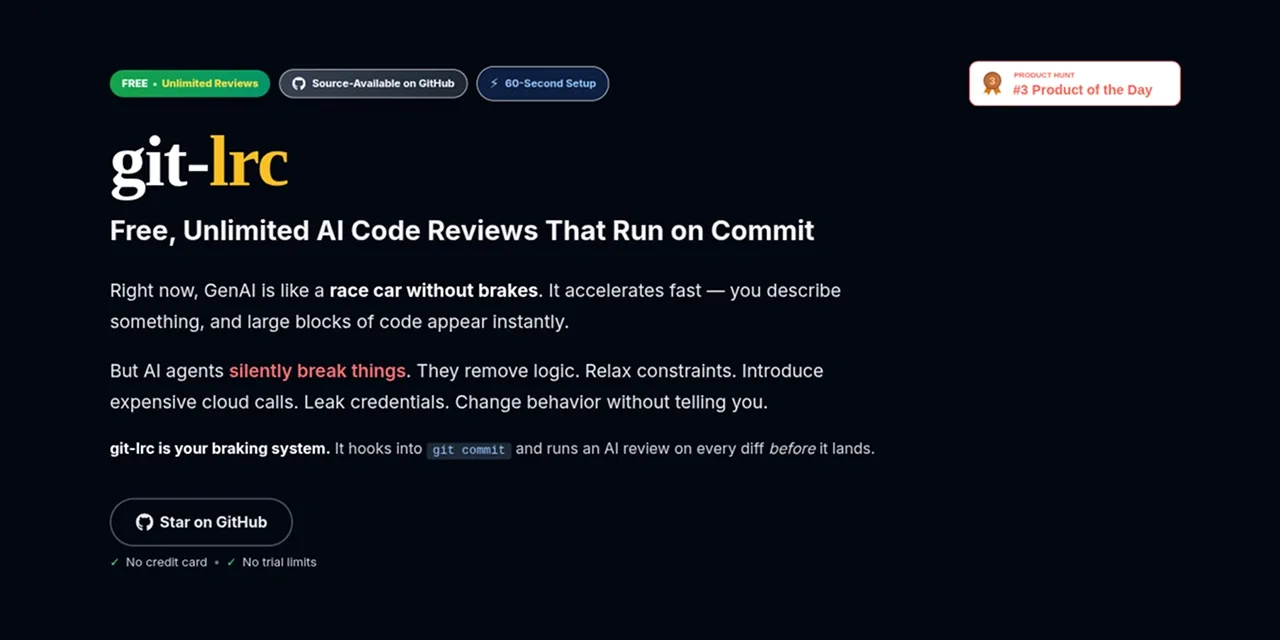
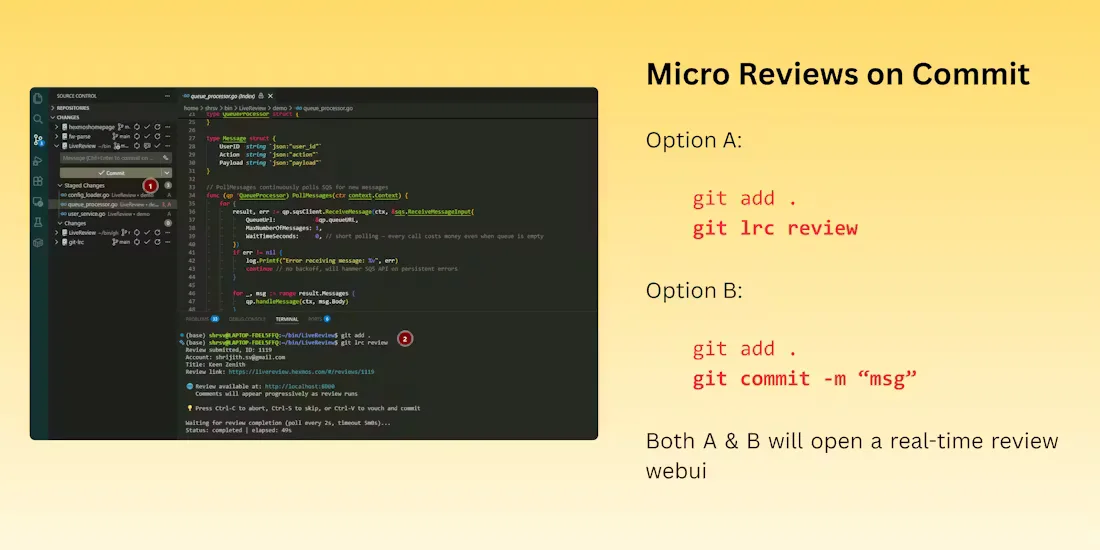
Tools are emerging to formalize this. For instance, our own git-lrc (Literate Review Commit) is a command-line tool that wraps Git to enforce this handover. Instead of `git commit`, you run `git lrc`. It prompts you to paste the AI's explanation and your own reasoning directly into a structured commit message.
The git-lrc CLI prompting for the LLM explanation and developer reasoning during a commit.
It creates a permanent, searchable record of why the code exists. It's a self-imposed code review for the founder flying solo. You can't commit the code until you've proven you understand it.
A Git log showing a detailed commit message generated by git-lrc, including the original prompt and the AI's explanation.
The Catch: What to Ignore
The Hacker News thread is full of opinions. Most fall into two camps, and both are traps for an indie founder.
The Purist: "I write every line myself for quality." This is an admirable, artisanal approach. It is also a losing strategy in 2026. Your competitor is shipping three features in the time it takes you to perfect one. You will be outmaneuvered. The goal is not to avoid the tool, but to master its risks.
The Paster: "If it works, ship it. Move fast." This is reckless. It leads directly to the anxiety that sparked the HN thread. You are not building a product; you are assembling a time bomb of technical debt and operational risk. Your speed is an illusion that evaporates at the first sign of trouble.
The table below outlines the trade-offs. You aren't choosing between speed and safety; you're choosing a role for yourself.
Approach | Velocity | Safety | Maintainability | Your Role |
|---|---|---|---|---|
The Paster (YOLO) | Very High | Very Low | Brittle | Stenographer |
The Purist (Manual) | Very Low | High | High | Artisan |
The Reviewer (This Workflow) | High | High | High | Editor-in-Chief |
What Breaks in Production?
So what actually breaks? It's the implicit assumptions. The AI assumes a pristine environment. It assumes valid inputs. It assumes dependencies never change. It assumes timezones don't exist.
What breaks in production is reality.
Your job as the founder and chief engineer is to be the advocate for reality. The "Cognitive Handover" workflow is how you inject that reality check before you ship. Don't just paste a production error back into ChatGPT. Use your logs, use a debugger, understand the state of your system at the moment of failure. Then, armed with context, you can ask the AI for help. But you're in the driver's seat.
The debate isn't "AI vs. no AI." That ship sailed years ago. The question is how to use it to build a resilient, maintainable product when you're the only one on call. Stop being a passive consumer of generated code. Become an active, demanding, and rigorous reviewer.
Your job isn't to write every line of code anymore. It's to own every line of code that ships. That's how you build something that lasts longer than a weekend. And when you're ready to show people what you've built, you can browse all categories to see what your peers are launching.