You’re staring at your dashboard. Twelve signups since you pushed the launch live on Tuesday. Not bad for a weekend project. Then your phone buzzes. It’s a link to Hacker News. The title hits you like a brick: “We're releasing the weights of Mistral Large 4.”
The FOMO is instant. Should you drop everything? Is your stack already a dinosaur? Your mind races. You could build that feature you thought was impossible. You could slash your OpenAI bill. You could finally own your whole stack, end to end.
Slow down. Let’s talk about what actually happened, and what it means for someone who needs to ship something by Sunday night.
What Actually Dropped
Mistral didn't just open-source a model. They dropped the keys to a top-tier, GPT-5 class intelligence. This isn't another 7B parameter toy. This is the real thing.
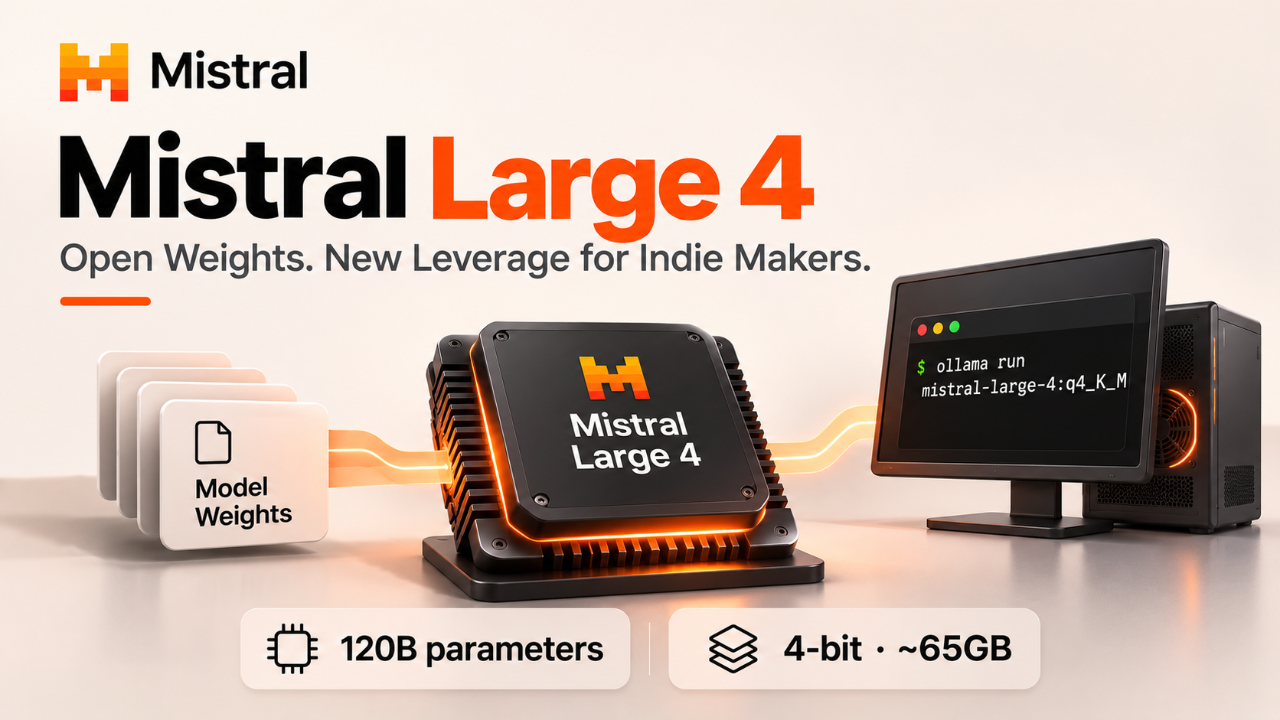
Mistral Large 4 is a 120-billion parameter model. The raw weights, in bfloat16 format, clock in at a hefty 240GB. They released both the base model and, more importantly for us, an instruction-tuned version ready for chat and task-following. This is a direct shot at the closed-API incumbents.
Within hours, the community did its thing. Quantized versions are already on Hugging Face. We're talking 4-bit GGUF files that shrink the model down to around 65GB. That’s still massive, but it puts it in the realm of possibility for a single high-end GPU, not a whole datacenter.
This is not an incremental update. This is a step-change in what a solo founder can wield. The gap between your capabilities and a16z-funded labs just got a little smaller.
Why a Solo Founder Should Care
You shouldn’t care because it’s a shiny new toy. You should care because open weights are leverage.
For two years, we’ve been building on sand. We’ve all been renting our app’s “brain” from a handful of companies in San Francisco. They can change the pricing, deprecate a model, or shift its behavior overnight. We saw it with the GPT-3.5 Turbo updates in 2024. That’s platform risk. Mistral Large 4 is your insurance policy.
Owning the model, or at least having the option to, unlocks three things:
Control over your destiny. No more surprise API bills that kill your margin. No more models getting “dumber” after an unannounced update. You control the updates. You control the behavior.
Deeper customization. Fine-tuning on a model of this caliber was previously unthinkable without a multi-million dollar research budget. Now you can train it on your proprietary data to create a moat that no one can copy by just stealing your prompts.
New product categories. Think fully on-premise, air-gapped AI for enterprise clients. Think privacy-first apps that do all processing locally. This opens up entire new markets in developer tools, security, and productivity that were impossible when every call had to go to a third-party server.
This isn’t just about saving money on tokens. It’s about owning a core piece of your value proposition.
How to Run It This Weekend
Reading about it is one thing. Feeling the power is another. You can get this running in under an hour. Do not start by downloading a 240GB file. Use the tools built for this.
Your goal is to get from zero to a chat session on your own machine. Here’s how.
Step 1: Install Ollama. If you haven't already, this is the homebrew of local LLMs. It handles the downloading, the quantization, and running the local server. It’s a single command.
Step 2: Pull the model. The community has already uploaded quantized versions. You'll want a 4-bit version to start, which balances performance and quality. It’s a big download, but it’s a one-time thing.
ollama run mistral-large-4:q4_K_MThis command downloads the 4-bit, medium Kenten-M quant and drops you directly into a chat interface in your terminal. Go ahead, ask it some questions. Feel how fast (or slow) it is on your hardware.
Step 3: Talk to it via API. Ollama automatically exposes an OpenAI-compatible endpoint at `localhost:11434`. This is the magic. You can use the official OpenAI Python library to interact with your local model, with minimal code changes.
import openai

client = openai.OpenAI(
    base_url = 'http://localhost:11434/v1',
    api_key='ollama', # required, but unused
)

response = client.chat.completions.create(
    model="mistral-large-4:q4_K_M",
    messages=[
        {"role": "system", "content": "You are a helpful assistant."},
        {"role": "user", "content": "Why are open-source LLM weights important?"},
    ]
)
print(response.choices[0].message.content)
That’s it. You’re now running a world-class LLM locally. The next step from here isn’t to build a GPU rig in your closet. It’s to use a serverless GPU provider like Replicate, Modal, or Lepton. They give you the power of self-hosting without the pain of self-managing. But for a weekend test, your local machine is all you need.
The Catch: This Isn't Free
There's a reason we all started with APIs. They’re easy. "Free" as in open-source weights is not "free" as in zero cost. The cost just moves from your Stripe invoice to other parts of your life and business.
The real cost of self-hosting is a tax on your focus. You are a founder, not a machine learning operations engineer. Every hour you spend debugging CUDA drivers, provisioning GPUs, or optimizing inference is an hour you’re not spending talking to users. It's a distraction from the only thing that matters: shipping a product people want. We've written before about the real cost of self-hosting LLMs, and the calculus hasn't changed.
Running this in production is a serious commitment. A single NVIDIA H100 GPU costs thousands per month to rent, and you’ll likely need more than one for reliable throughput. Cold starts are a nightmare. Scaling is your problem now. You've just taken on a second job as a DevOps engineer for a very complex, very expensive piece of infrastructure.
Is It Worth Switching?
This is the only question that matters. The answer is not "it depends." It’s "no, yes, and maybe."
For your existing product with paying users? No. Do not rip out your working GPT-4 or Claude 4 integration this week. You will break things. Your prompts will behave differently. The performance characteristics are unknown. Your users don't care what model you use; they care if your app solves their problem. Don't risk your traction for a new tech stack.
For a new, non-critical feature? Maybe. This is the perfect place to experiment. Building an internal tool for summarizing user feedback? Go for it. Adding an experimental "AI draft" button that can afford to be a little slow? Perfect. This lets you learn the model's quirks in a low-stakes environment.
For a new product built from scratch? Yes. If your core value proposition is tied to the model itself—extreme privacy, deep domain-specific customization, or a cost structure that would be impossible with APIs—then starting with Mistral Large 4 is a strategic advantage. This is how you build a defensible moat in 2026. For anyone choosing their first AI stack today, this has to be a serious contender.
What Breaks When You Go to Production
The leap from your laptop to serving live traffic is a chasm. Here’s what’s waiting for you on the other side:
Cold Starts. Loading 65GB of weights into VRAM is not instant. Your first user of the day could be waiting 20-40 seconds for a response unless you pay to keep a GPU warm 24/7.
Throughput Nightmares. An API from OpenAI is a massively concurrent system. Your single GPU is not. It can handle one request at a time, maybe a few with clever batching. A sudden spike in traffic will create a massive queue.
- Prompt Fragility. The clever system prompt you spent weeks perfecting for Claude 4 will produce garbage from Mistral Large 4. You have to start your prompt engineering process from scratch. All your evaluation suites need to be re-run.
The Sysadmin Trap. You are now responsible for everything. GPU availability, driver updates, Python dependencies, container orchestration. It's a full-time job.
Before you commit, understand the trade-offs. Here is how the options stack up:
Option | Cost Model | Control | DevOps Burden | Best For |
|---|---|---|---|---|
Closed API (GPT-5) | Pay-per-token | Low | Zero | MVPs, core products |
Serverless GPU (Replicate) | Pay-per-second | Medium | Low | Custom features, scaling |
Self-Hosted (Your AWS) | Pay-per-hour (24/7) | Total | High | Deep tech, enterprise |
The release of Mistral Large 4's weights is a landmark event. It gives us, the independent makers, a powerful new weapon. But a weapon is only useful if you know when and how to use it. Don't get distracted by the hype. The goal isn't to run the latest model. The goal is to build something useful.
So spend Saturday playing with it. Get a feel for its power. But on Sunday, get back to what matters: shipping. Build that feature, solve that user problem, and then tell the world about it. Chasing SOTA models is a great way to never launch. The real work is still finding your first 100 users. Once you have them, you can worry about which AI model is going to serve the next 100,000.