
Hubfly space
Cloud infrastructure for containers, VMs, and databases
Screenshots
Freemium
Cloud Computing
Hosting
DevOps
Built with Golang
 React
 AWS
GolangReactAWSWhat is Hubfly space?
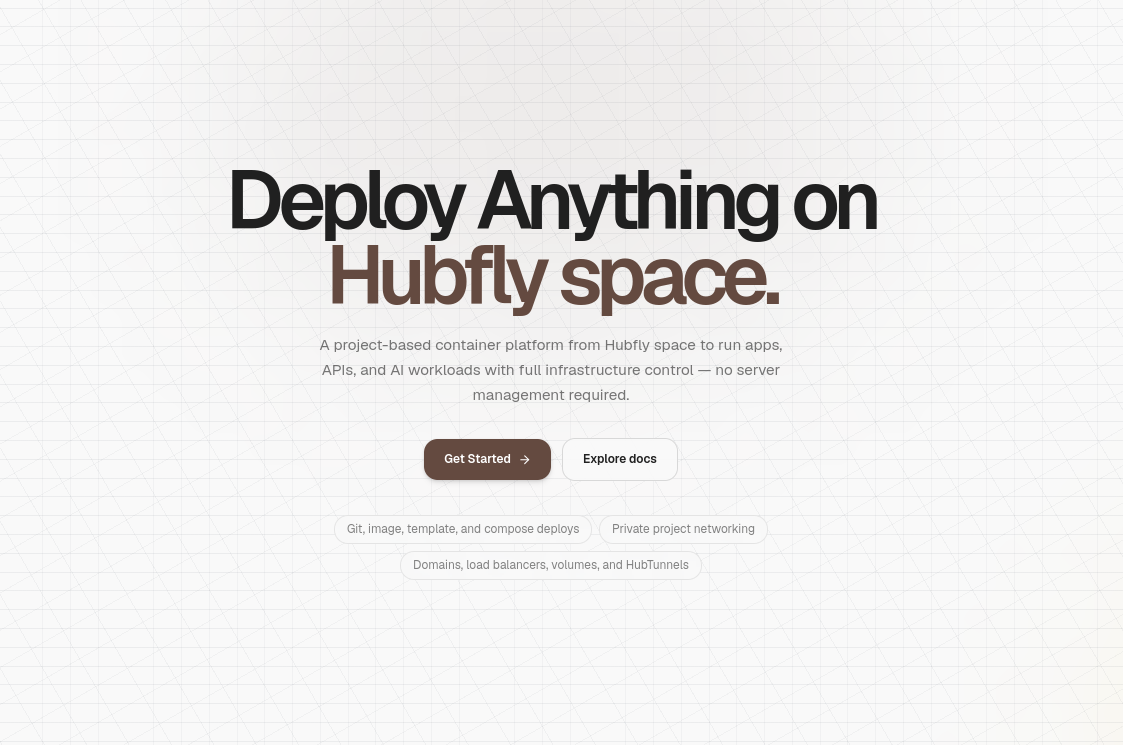
Hubfly space is an integrated cloud platform designed to run web applications, virtual machines, databases, and background services in a unified workspace. Instead of forcing developers to assemble disparate tools or handle complex infrastructure setups, it combines multiple hosting primitives into an isolated per-project network.
The platform addresses the classic trade-off between restrictive application hosts and manual cloud providers. App platforms offer quick setup but restrict low-level control, while raw infrastructure providers require deep configuration for networking, ingress, and storage. Hubfly space sits between these models by providing managed deployment workflows alongside direct access to Linux primitives and internal routing.
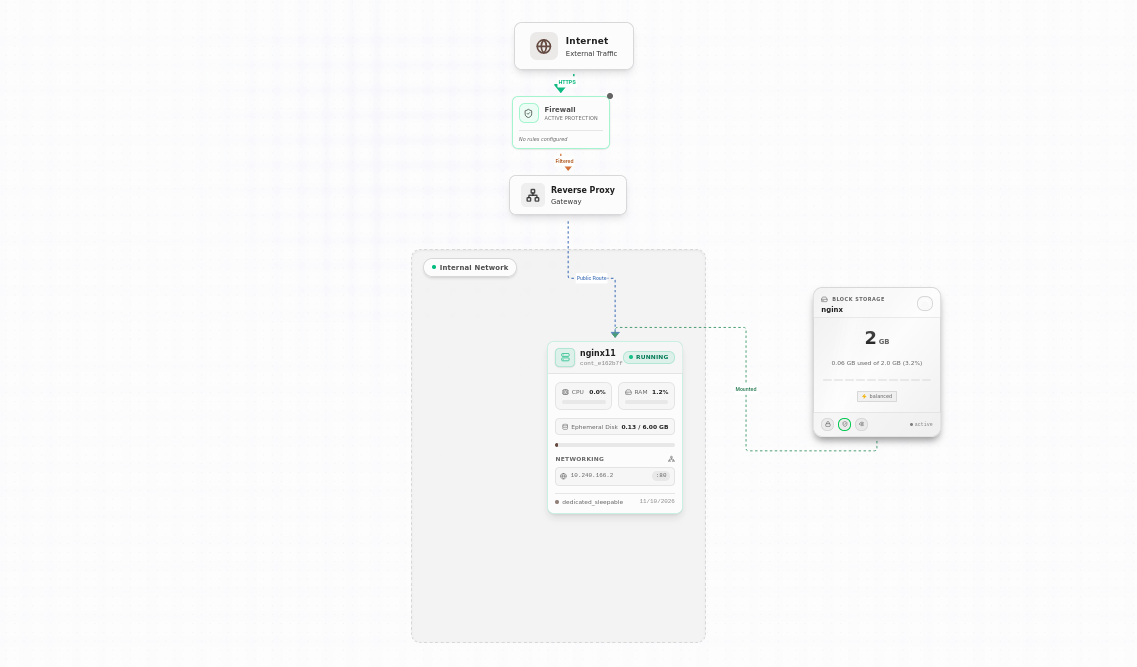
Its approach combines daemonless Linux container cells with KVM virtual machines, native S3-compatible storage, managed databases, and real-time WebSockets. Workloads stay private on an internal mesh by default, communicating securely without opening ports to the wider web unless explicitly configured.
Who is it for?
Hubfly space is built for technical teams and engineers who want high operational control without managing raw cloud networks.
- Solo developers and hobbyists hosting side projects that need to scale to zero when idle.
- Startup engineering teams deploying multi-service backends alongside databases and workers.
- Platform engineers building multi-tenant tools or AI agents that need isolated execution sandboxes.
- Developers requiring root access and live hardware resizing via dedicated virtual machines.
Key features
- Cell Containers: Run daemonless Linux containers isolated by cgroups v2 and seven namespaces, featuring scale-to-zero capability and live vertical autoscaling without restarts.
- Box Virtual Machines: Dedicated KVM machines offering root access, live vCPU and RAM hotplugging, kernel nftables firewalls, and an in-browser VNC console.
- Managed Databases: Dedicated instances for PostgreSQL, MySQL, and SQLite (libSQL) featuring enforced TLS, IP allowlists, internal app bindings, and built-in SQL query editors.
- Realtime WebSockets: Pusher-compatible WebSocket servers supporting presence channels, webhooks, message history, and end-to-end encryption with user-managed keys.
- Object and Media Storage: S3-compatible storage buckets offering scoped access keys, dynamic image variants, and automated HLS video transcoding.
- Isolated Private Mesh: Automatic internal networking where project services resolve each other by name while remaining shielded from the internet.
- Developer CLI and AI Skill: Command-line tooling for local builds, database bindings, and multiplexed tunnels, alongside a portable SKILL.md setup for AI agents like Cursor and Claude Code.
- Sub-Accounts: Hierarchical tenant structure allowing parent platforms to provision isolated wallets, projects, and scoped API keys for their own end users or autonomous agents.
Pricing
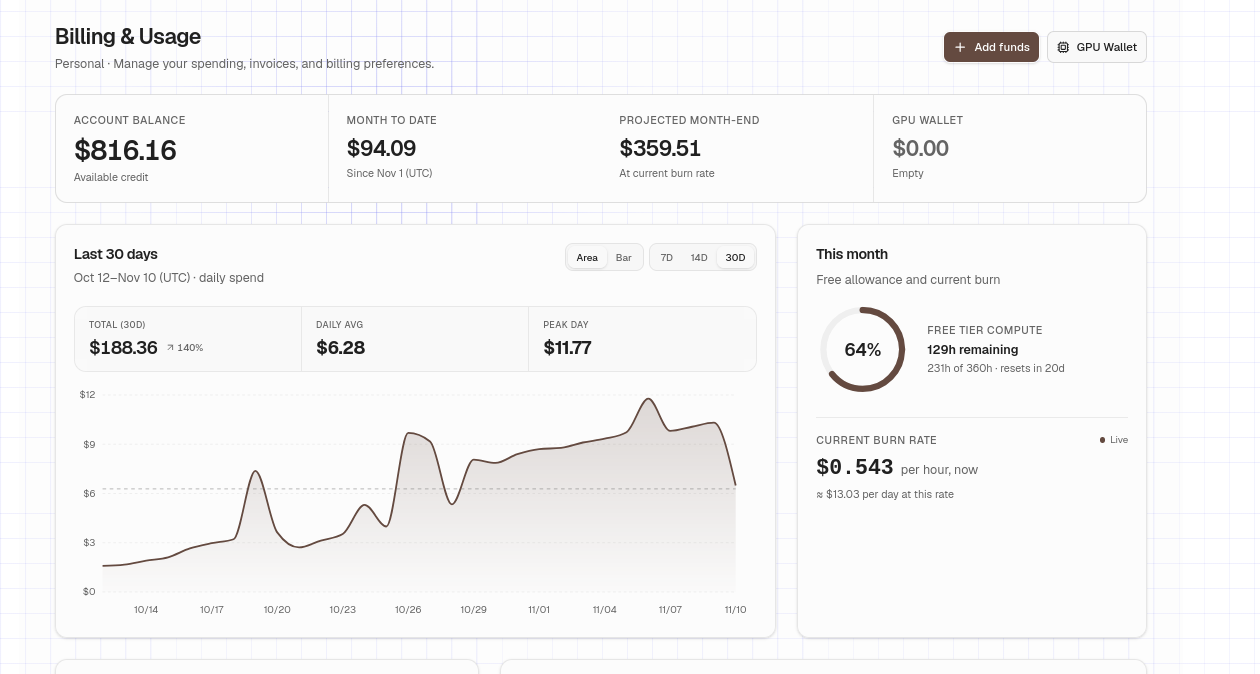
Hubfly space operates on a usage-based Freemium billing model calculated in 2-minute micro-buckets. The free shared tier includes 360 hours of shared compute runtime and 1 GB of storage every month. Once past the free allocation, CPU costs $0.004 per vCPU per hour, RAM costs $0.002 per GB per hour, and storage is billed at $0.00001536 per GB per hour (roughly $0.011 per GB per month). Managed databases and real-time servers start at approximately $1.92 to $2.02 per month for nano instances. Sleeping workloads pause compute and memory billing completely. A minimum one-time deposit of $5 unlocks extended capacity, and a zero account balance halts paid resources rather than accruing surprise debt.
Alternatives
Render: Render delivers straightforward Git-based container and web hosting, but Hubfly space adds root-accessible KVM virtual machines, native live vCPU hotplugging, and built-in Pusher-compatible WebSockets.
Fly.io: Fly.io runs containers inside microVMs globally, whereas Hubfly space offers distinct container cells alongside dedicated persistent KVM machines, native S3-compatible storage pipelines, and built-in mailboxes.
Railway: Railway simplifies infrastructure for growing stacks, while Hubfly space provides deeper multi-tenant sub-account provisioning, granular 2-minute billing buckets, and native support for SQLite libSQL instances.
FAQ
How does billing work when my services are idle?
Containers configured to scale to zero automatically pause when network traffic drops. During sleep periods, CPU and RAM charges drop to zero, leaving only minimal baseline storage fees.
What is the difference between Cell containers and Box virtual machines?
Cell containers run as lightweight, daemonless Linux processes suited for web services and APIs. Box instances are full KVM virtual machines with root permissions, live resource hotplugging, and browser-based VNC access.
Loading...
Related products
View all
Petabyte
Rent verified GPUs by the hour, or earn from hardware you al
0
Cloud Computing
0
Cloud Computing


MailTova
Professional domain email hosting with webmail and DNS setup
0
Email, Hosting, Web Hosting
0
Email, Hosting, Web Hosting

Vault Desk
Zero-knowledge encrypted cloud storage for your files.
1
Cloud Computing, Cloud Storage
1
Cloud Computing, Cloud Storage

More categories
All categories







Launched in Week 4, 2027
See the week
SuperCalc
Run everyday calculations in your browser
0
Calculator, Finance, Utility
0
Calculator, Finance, Utility
74d20h6m
Launches in74days
:20hours
:06mins
:15secs
Dog Age Calculator
Free dog-to-human age converter by size & birthday
0
Productivity, Pets, Calculator
0
Productivity, Pets, Calculator
74d20h6m
Launches in74days
:20hours
:06mins
:15secs